

A question most Step 1 guides never address: are you studying at the biologically optimal time?
You’ve spent months assembling high-yield resources: First Aid, Pathoma, UWorld, Anki. You have the materials. What many students lack is a deliberate scheduling framework: one aligned with neurobiology (circadian rhythm, attentional control, and sleep-dependent memory consolidation) rather than the vague default of “study until I’m exhausted”.
That mismatch is likely costing more performance than any single resource choice ever will.
The Hidden Variable: Your Brain Is Not Constant
Most study schedules implicitly assume cognitive capacity is linear and uniformly available, equally accessible at 8:00 AM and 10:00 PM. Physiologically, that assumption is incorrect. Preparing for Step 1 as if it were true is one of the most common and most costly errors in study design.
Human cognition is governed by at least two interacting biological rhythms that materially influence encoding, attention, and recall:
1) Circadian Rhythm (≈24-hour cycle)
Regulated by the suprachiasmatic nucleus (SCN) of the hypothalamus, the circadian system coordinates daily oscillations in cortisol, core body temperature, melatonin, and neuromodulator tone. These fluctuations create predictable windows of heightened cognitive performance and periods in which recovery and consolidation are favored; windows many students fail to leverage.
2) Ultradian Basic Rest–Activity Cycle (≈90–120 minutes)
First described by Nathaniel Kleitman (who also co-discovered REM sleep), the Basic Rest–Activity Cycle (BRAC) persists during wakefulness as alternating phases of higher neural efficiency and relative cognitive downshift. Trying to sustain peak output well beyond a ~90-minute work interval is less “discipline” than it is a mismatch with normal neurophysiology.
Understanding these rhythms provides a usable blueprint for schedule architecture. Ignoring them often leads to a predictable failure mode: spending high-cognition hours on low-yield tasks (email, logistics) and reserving the hardest material for a time when the prefrontal cortex is already functionally depleted.
The Cortisol Awakening Response: A Built-In Cognitive “Launch Window”
Within ~30–45 minutes of waking, cortisol rises rapidly toward its daily peak, which is a normal phenomenon known as the cortisol awakening response (CAR). In physiologic (non-pathologic) ranges, this rise is not “stress” in the colloquial sense. It is an adaptive signal that increases arousal and executive control, supporting prefrontal cortex–dependent working memory and facilitating hippocampal encoding of new declarative information; exactly the cognitive profile required for learning novel, high-complexity material.
This is the biological basis for
why mornings are productive for many people.
Critical caveat: the Yerkes–Dodson principle
The relationship between cortisol/arousal and performance follows an inverted-U, not a linear trend. Moderate arousal tends to optimize performance; excessive or sustained elevations, common with sleep restriction, inadequate recovery between blocks, and chronic test-related anxiety, are associated with poorer hippocampal-dependent learning, reduced working memory efficiency, and faster forgetting.
If your studying becomes progressively more frantic yet less productive over the course of a dedicated period, that is often not a “willpower” issue. It is a physiology-and-schedule design issue, and the solution is better architecture, rather than more hours: sleep, recovery, and appropriately timed high-cognitive work.
Know Your Chronotype Before You Build Your Schedule
A common failure of circadian-based study advice is the implicit assumption that everyone functions best early in the morning.
In reality, chronotype varies substantially. An estimated 30–40% of individuals fall closer to an evening chronotype, with later timing of circadian phase markers (including the cortisol rhythm and core body temperature minimum/peak) and, correspondingly, later windows of maximal alertness and executive function. If you have an evening chronotype and force a 6:00 AM “deep work” block because a guide recommends it, you are working against your neurobiology.
A practical chronotype check
On a day without an alarm and without external obligations:
- What time do you naturally wake?
- When do you feel most cognitively sharp?
That highest-alertness window, wherever it falls, should anchor your primary deep work block. The scheduling frameworks that follow should be applied to your peak physiology, not to a prescribed clock time.
The Architecture: Building a Day That Compounds
Below is a practical, evidence-informed daily structure grounded in circadian and ultradian physiology. Adjust the clock times to match your chronotype; the sequence and timing logic are what matter.
Block 1. The Cortisol Window: Deep Work (90 minutes)
Timing: within ~1–2 hours of natural waking
This is typically the day’s highest-yield cognitive window. Reserve it for the most demanding work: content that requires sustained attention, intact working memory, and novel problem-solving. For Step 1, that usually means:
- fresh UWorld blocks targeting your weakest systems
- first-pass mastery of complex physiology/pathways (e.g., renal acid–base, cardio pressure–volume loops)
- any task that requires constructing explanations, not just recognizing facts
Rules: phone out of reach, no email, no “warm-up” scrolling. Your arousal system is already online via the CAR; don’t spend the peak on low-yield inputs.
Ultradian Recovery (20 minutes)
Timing: immediately after each 90-minute block (non-negotiable)
At the end of a ~90-minute work bout, the ultradian cycle commonly shifts into a short recovery phase. Pushing through rarely adds productive time; it tends to reduce cognitive efficiency in the next block. Use this interval for low-stimulation recovery, such as brief walk, hydration/food, light conversation, or quiet rest. It is preserving throughput across the day.
Block 2. The Consolidation Window: Active Review (90 minutes)
Timing: the second 90-minute block within your peak period
This block is still high-performance, but typically with slightly less capacity for novel encoding. Use it for consolidation of tasks that demand reasoning and retrieval, but are anchored in material you’ve already introduced:
- Anki review: spaced repetition is active recall, not passive rereading. It fits best when you’re still cognitively engaged, but primarily reinforcing existing traces rather than building them from scratch.
- UWorld review + error analysis: determining why an answer was wrong (conceptual gap vs. misread vs. flawed reasoning) is executive work and is well-matched to this window.
- Pathoma / annotated First Aid review: for systems already in progress, where the goal is integration and reinforcement rather than first exposure.
Block 3. The Afternoon Integration Window (60–90 minutes)
Timing: early-to-mid afternoon, often coinciding with the post‑prandial circadian dip (commonly ~1–3 PM)
This dip is physiologic, reproducible, and not a character flaw. During this window, core body temperature trends downward, alertness decreases, and processing speed is measurably reduced. Rather than forcing high-novelty work, pivot to lower-friction integration tasks:
- Clinical image/vignette patterning: dermatology morphologies, radiology fundamentals, pathology slide recognition
- Organizing/annotating notes generated during earlier deep-work blocks
- Targeted visual reinforcement: a focused Sketchy or Boards & Beyond segment tied to a concept you’ve already introduced (reinforcement, not first exposure)
- A deliberate 20-minute nap if feasible; evidence for performance benefits of brief, early-afternoon naps is strong (e.g., Mednick and colleagues)
Block 4. The Evening Synthesis Window (60 minutes)
Timing: ~2–3 hours before sleep
This final block should be lowest intensity and highest integration, designed to organize what you’ve already learned and set up sleep-dependent consolidation. Appropriate tasks include:
- a final, lightweight pass through the day’s Anki (prioritizing marked/“hard” cards)
- a brief 3–5 sentence synthesis of the most important mechanism learned that day, written in plain language without notes
- reviewing a single UWorld explanation for a recurring question pattern you want to consolidate overnight
Avoid introducing new, high-complexity material in this window. The goal is to give the hippocampus clean, structured inputs before sleep initiates consolidation.
Sleep: The Non‑Negotiable Variable Most Schedules Ignore
You cannot out-study a sleep deficit.
During NREM slow-wave sleep, hippocampal–neocortical dialogue supports replay of recently encoded material and its stabilization into longer-term cortical storage. During REM sleep, new information is more extensively integrated with existing associative networks, one biologic substrate of the “pattern recognition” clinicians rely on.
Reducing sleep to create more study time rarely produces a net gain. It predictably undermines consolidation of what you learned the day before and impairs next-day encoding capacity.
The evidence is consistent: sleep restriction meaningfully reduces learning efficiency, including hippocampal-dependent encoding (Matthew Walker and colleagues have summarized these effects extensively, drawing on foundational experimental work from the UC Berkeley sleep lab and related groups). For Step 1 preparation, 7–8 hours of sleep is not a lifestyle preference, but it is a clear performance intervention.
The 3‑Day Energy Audit
Before you redesign your schedule, collect objective data on your own performance physiology. For the next three days, keep a simple log:
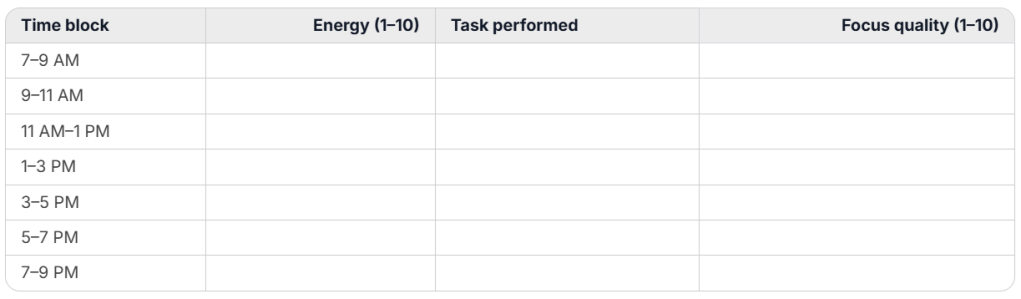
After three days, your peak cognitive window should be obvious. Anchor Block 1 (Deep Work) to your two highest-scoring intervals. Use your lowest-scoring interval(s), often the early afternoon, for image review and lower-intensity integration work.
Build the schedule around your data, not around assumptions, guilt, or someone else’s morning routine (very important!).
The High-Yield Takeaway
A 260+ scorer is not simply working harder. More often, they’re working with better architecture. They align their highest-cognitive-demand tasks with predictable biologic performance peaks, and they protect those windows with the same rigor they apply to question blocks.
Your brain is not the obstacle; it is the primary resource. Learn its operating constraints as deliberately as you learn the organ systems it regulates, and then build your schedule around them.
Circadian Coding: Student Q&A
Q1: I’m a natural night owl. Every study guide tells me to wake up at 5 AM and grind. Am I sabotaging myself by following that advice?
A: In many cases, yes, if you’re forcing an early schedule without a true phase shift.
Chronotype is not simply a preference or a habit; it is a biologically anchored trait with a documented genetic contribution, including variation in clock-related genes (e.g., PER3, CLOCK). Evening chronotypes typically demonstrate later timing of circadian phase markers, such as the cortisol awakening response, core body temperature rhythm, and dim-light melatonin onset (DLMO). If you impose a 5:00 AM start without adequate entrainment, you may be studying during what is functionally your biologic “middle of the night”, when executive function and learning efficiency are predictably reduced.
Chronotype does have limited malleability. With consistent wake times, bright morning light exposure, and reduced light at night, many people can shift earlier by ~1–2 hours over several weeks. However, most individuals will not fully convert from a true evening chronotype to a morning chronotype within a typical dedicated period.
Use the 3-day audit to identify your actual peak window. If your best cognition reliably occurs from 2–6 PM, that is your Deep Work block. Protect it as aggressively as a morning-type protects 7–11 AM. The USMLE does not penalize evening chronotypes; it penalizes schedules that ignore physiology.
Q2: You recommend 90-minute ultradian blocks, but a timed UWorld block is 40 questions in ~60 minutes. How do I reconcile that with the BRAC framework?
A: A 40-question timed block fits well within a 90-minute ultradian cycle, and the remaining time is clinically useful.
A timed UWorld block (≈60 minutes) leaves ~20–30 minutes in the same high-activation window for immediate review of flagged items. From a learning standpoint, rapid review while working-memory traces are still “online” can improve error-based learning compared with deferring all review to later.
A workable structure for a 90-minute Deep Work block:
- 0:00–1:00 — 40-question timed block under exam conditions
- 1:00–1:20 — immediate review of flagged questions + high-confidence errors only
- 1:20–1:30 — transition/reset before ultradian recovery
Save deeper post-mortem work (“what is the systematic gap?”) for your second, consolidation-focused block, when you can analyze more reflectively.
Q3: Is Anki really active recall? It feels passive compared to UWorld. Am I undervaluing it?
A: Likely yes, and your intuition is pointing to a different distinction.
Both Anki and UWorld leverage retrieval practice, which is the core mechanism behind their effectiveness. The difference is not active vs. passive; it’s the type of cognitive demand:
- UWorld: high retrieval + high novelty/integration (multi-step reasoning under time pressure)
- Anki: high retrieval + low novelty (targeted recall of previously learned material)
That lower novelty is a feature, not a flaw. It makes Anki efficient for consolidation. Spaced repetition is designed to counter predictable forgetting by scheduling retrieval near the point of expected decay. UWorld does not reliably track your personal retention timeline.
Think of them as complementary: UWorld builds clinical reasoning; Anki protects the underlying knowledge base from attrition.
Q4: What about caffeine? I use it to push through the afternoon dip. Is that working against me?
A: Used strategically, it can help. Used reflexively, it often backfires.
Caffeine primarily acts as an adenosine receptor antagonist. It reduces perceived sleep pressure rather than creating energy. Two common problems when using caffeine to “erase” the afternoon dip:
- Sleep disruption: with a typical half-life of ~5–7 hours (variable with CYP1A2 genetics), caffeine taken at 2 PM can meaningfully impair sleep onset and reduce slow-wave sleep, undermining overnight consolidation.
- Circadian dip ≠ purely adenosine: the early-afternoon decline is partly circadian. Caffeine may improve subjective alertness more than it restores peak-level processing speed for complex, novel work.
A more effective approach for many students is a 10–20 minute nap (if feasible), optionally paired with modest caffeine timed to take effect as you wake (“caffeine-nap” concept). If you cannot nap, consider limiting caffeine to earlier in the day and using the dip for lower-novelty integration work.
Q5: Some students pull all-nighters the week before Step 1 to cram. What does neuroscience say?
A: It’s one of the fastest ways to reduce return on months of preparation.
Sleep is required for both (1) restoring encoding capacity for new learning and (2) consolidating recently learned material into more stable long-term representations. Sleep deprivation impairs hippocampal-dependent encoding and degrades next-day learning efficiency. The practical outcome is simple: you may spend more hours “studying” while retaining less and retrieving slower.
The final week should prioritize consolidation: high-yield review, maintenance Anki, selective question practice, and aggressively protected sleep.
Q6: My Step 1 exam starts at 8 AM. How do I train my brain to be sharp then, even if I’m an evening type?
A: Use deliberate circadian entrainment. The goal isn’t to permanently change chronotype; it’s to shift your schedule so peak performance is available at exam time.
A pragmatic 2–3 week protocol:
- Fix wake time (e.g., 6:00–6:30 AM) daily. Wake-time consistency is one of the strongest entrainment signals.
- Bright light early: 10–15 minutes of outdoor light shortly after waking (or a 10,000-lux lamp when appropriate) to advance circadian phase and suppress residual melatonin.
- Train at target time: start your hardest blocks at 8 AM (timed UWorld, NBME-style practice). You’re conditioning performance to that hour.
- Anchor breakfast timing: meal timing can reinforce the schedule as a secondary zeitgeber.
By exam day, consistent entrainment typically shifts physiology meaningfully toward the required start time. You may not be at your lifelong chronotype “ideal”, but you can be synchronized, well-rested, and reliably sharp, an advantage that matters more than forcing last-minute heroics.
Have a question about the neuroscience of Step 1 preparation? Submit it for the next Q&A edition.
Full Reference List: Circadian Coding for USMLE Step Exams
PMID: 6819628, PMID: 38472275, PMID: 1958644, PMID: 2420557, PMID: 31236513, PMID: 40917570, PMID: 24535929, PMID: 9416776, PMID: 24508619, PMID: 26818772, PMID: 15204030, PMID: 20970005, PMID: 27105036, PMID: 12689474, PMID: 24508619, PMID: 25999722, PMID: 19330153, PMID: 17641736, PMID: 26881112, PMID: 17466428, PMID: 29213714, PMID: 15511597, PMID: 10481183, PMID: 29213714, PMID: 25893159, PMID: 17936039, PMID: 31336976, PMID: 29148844, PMID: 12841365, PMID: 24635757, PMID: 28276850, PMID: 9779516, PMID: 20931356, PMID: 25652815, PMID: 15892914, PMID: 26016658, PMID: 40537913, PMID: 11007448, PMID: 9694306, PMID: 28934525, PMID: 25206041, PMID: 26148023, PMID: 16507066, PMID: 25999314, PMID: 21252317, PMID: 22034416, PMID: 31549261, PMID: 23242770, PMID: 22273437, PMID: 40282153, PMID: 15450165
 usmleblueprint.com
Leave a comment