
What Is Actually Changing, and What Is Not
Let me begin with the reassurance, because the student forums do not lead with it: the content of your exam has not changed. Your biochemistry, pathophysiology, and clinical reasoning frameworks remain exactly what they were. The USMLE content outline is unaltered. Your First Aid, UWorld, and Anki preparation is entirely valid.
What is changing is the architecture of your exam day, and that architecture has meaningful implications for your pacing strategy, your psychological management between blocks, and your break utilization.
Here is the structural change in precise terms:
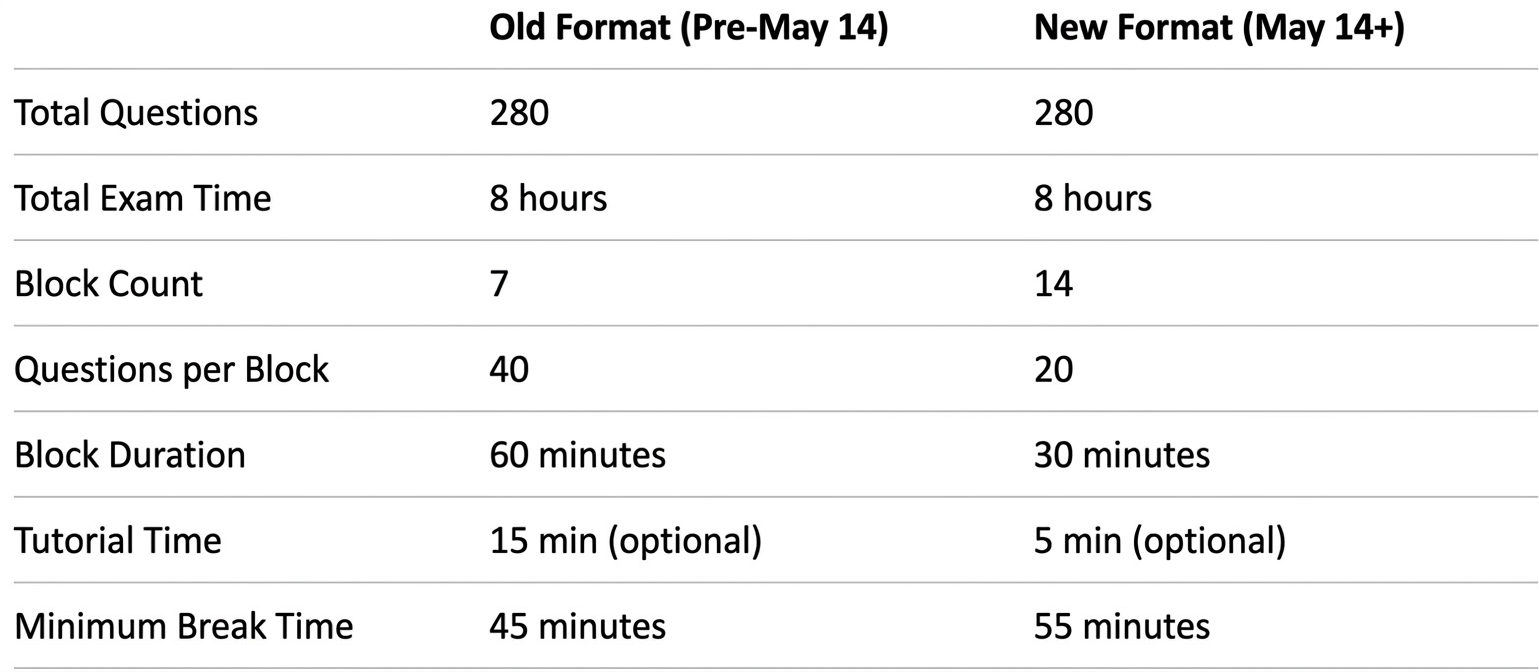
Two things are happening simultaneously. The exam day is being compressed into more, shorter sprints, which demands faster psychological transitions and eliminates warm-up drift. And the recovery architecture is being expanded: more guaranteed break time and a cleaner interface designed to reduce cognitive friction at the question level. Both matter strategically, and both deserve your attention.
The Real Cost of a Slow Start: Now Quantified
In the previous 60-minute block structure, a student who spent the first few minutes settling in, briefly orienting themselves to the question, and engaging in partial rather than fully focused processing would already lose approximately 5% of their block time to unproductive cognitive drift.
In the new 30-minute block structure, the same three-minute warm-up costs 10% of your entire block.
Across 14 blocks, three minutes of warm-up drift per block adds up to 42 minutes of reduced cognitive efficiency across the exam day; time during which you are technically answering questions, but not operating at full processing capacity.
The solution is not to panic faster. It is to eliminate the ramp-up entirely through deliberate preparation. A well-trained examinees does not warm up during Block 1. They arrive at Question 1 already operating at full capacity because they have practiced that state repeatedly before exam day.
The Tutorial Is No Longer Your Buffer
Under the previous format, many students used the optional 15-minute tutorial as an informal settling period, allowing time to breathe, orient themselves, and mentally arrive before the first block began. That buffer is now effectively no longer available.
The new tutorial is 5 minutes. If you have been using tutorial time as a warm-up window, you need a replacement strategy. The five minutes before you click “Start Block 1” is now a critical transition period that should be deliberate, not accidental.
The pre-exam protocol recommended below addresses this directly.
The Strategic Framework: Four Adjustments for the New Format
Adjustment 1. The Cold Start Drill: Training Full Engagement from Question 1
In your UWorld and question bank practice, immediately adjust all timed sessions to 20-question blocks with a 30-minute timer. Avoid using 40-question blocks as a shortcut. You are not only practicing question volume, but also training a specific cognitive state: the ability to reach full engagement from Question 1, without a ramp-up period.
The pacing target in the new format is 90 seconds per question; identical to the old format’s average, but now with zero margin for a slow start. Practice hitting that pace from the first question of every block, every session. Within two weeks of consistent practice using 20-question blocks, the “cold start” becomes your default operating state rather than an anomaly that needs to be overcome.
One practical addition: in the three minutes before each practice block, do not review notes or check your phone. Sit with the blank interface. Breathe. Arrive at Question 1 mentally positioned rather than mentally still commuting.
Adjustment 2. The Revised Flagging Protocol: Surgical, Not Liberal
Under the old format, liberal flagging was a defensible strategy. With 40 questions in 60 minutes, a student could flag 10–12 items and still conduct a meaningful second pass in the remaining time.
In a 30-minute block with 20 questions, that calculus breaks entirely. Flag too liberally and you create a review queue that cannot be resolved in the time available, generating anxiety about unresolved flags during your first pass rather than clearing your cognitive channel for the question in front of you.
The revised flagging rule is to flag only when a specific, discrete piece of information, such as a single lab value or a precise clinical sign, could meaningfully change your answer upon second review. If your uncertainty is conceptual (you do not know the mechanism), flagging does not help you. Make your best educated answer, leave it unflagged, and move forward. Protect your forward momentum. It is your most valuable resource in a 30-minute block.
Adjustment 3. The 60-Second Transition Protocol: Cognitive Reset Between Blocks
With 14 blocks instead of 7, you will experience twice as many block transitions across your exam day. Each transition is a potential source of performance degradation if managed poorly.
The cognitive science is relevant here. Research on attention residue (Leroy, 2009) demonstrates that when we transition from one task to another while mentally unresolved thoughts from the prior task persist, cognitive performance on the new task is measurably impaired. Every second you spend after a block closes mentally reviewing missed questions, second-guessing flagged answers, or reconstructing what you “should have” done is attention residue you are carrying into Block N+1.
The moment a block closes, it enters a state of absolute cognitive finality; you cannot return to it. This is not a limitation, but a constraint that can be useful. It means that continued mental engagement with a completed block has no return on investment and carries a measurable opportunity cost.
Your transition protocol, practiced until it is automatic:
- Block closes → close your eyes for three seconds
- Drop your shoulders consciously. Physical tension carries psychological residue
- Take two slow diaphragmatic breaths (4-count inhale, 6-count exhale)
- Reset your posture upright
- Say internally: “That block is complete. This one is new.”
- Open the next block
This takes 60 seconds. Practice it after every block in every practice session until it is a conditioned reflex rather than an intentional act.
Adjustment 4. The Break Architecture: Use Your Extra 10 Minutes Strategically
This is the adjustment most students will miss because the panic about shorter blocks obscures the opportunity: the new format gives you 10 additional guaranteed break minutes compared to the old format (55 minutes minimum versus 45 minutes). Combined with the time saved by a shortened tutorial, your total recovery time across the exam day has increased, not decreased.
This matters because break quality determines the second half of your exam. A student who uses breaks strategically with brief movement, controlled nutrition, deliberate mental decompression sustains executive function significantly better across blocks 8–14 than one who sits inert or ruminates about prior performance.
A recommended break allocation for the new format:
- After every 2–3 blocks: 3–4 minute micro-break. Stand, walk to the bathroom, splash water on your face, consume a small snack if needed. Do not review notes.
- Mid-exam extended break (after block 7): 10–12 minutes. Eat a complete snack, walk, perform your transition protocol intentionally.
- Final third: Shorter micro-breaks only. Prioritize momentum over recovery at this stage.
The New Interface: Features You Should Practice Using Before Exam Day
The updated software introduces two features with direct tactical value that the majority of students are not practicing with:
Image Contrast Adjustment: For the first time, you can adjust the contrast of individual images during your exam. For dermatology presentations, radiology interpretations, and pathology slides—question types in which image clarity can be decisive—this represents a meaningful advantage. Practice using this feature in your question bank before exam day so that the action becomes automatic and does not cost you any time under pressure.
Improved Keyboard Navigation: The new interface is designed for efficient keyboard-only navigation. Students who master keyboard shortcuts eliminate the minor but real cognitive cost of mouse-dependent navigation under time pressure. Spend 30 minutes on the official USMLE Step 1 testing experience tool at usmle.org before your first new-format practice block. The interface should feel familiar, not novel, on exam day.
The Full Simulation Protocol: Building Exam-Day Readiness
Tactical adjustments mean nothing if they are not embedded in full-simulation practice. Recommended architecture for the final 4–6 weeks before your exam:
Weeks 5–6 out: Convert all timed question bank sessions to 20-question/30-minute blocks. Begin practicing the transition protocol after every block. Configure two full 14-block simulations in this window, including realistic breaks.
Weeks 3–4 out: Run at least one NBME self-assessment in the new 30-minute block format. Treat every practice session as exam-day simulation: same start time as your actual exam, same break structure, same transition protocol.
Final week: No new full simulations. Light 20-question blocks for maintenance only. The work is done. Arrive to exam day with a rested, calibrated nervous system, not a depleted one.
Takeaway
The May 14 update is not a content-related threat. It is a pacing and psychological management challenge that can be trained into an advantage, and it is fully addressable with deliberate preparation.
The students who will be disrupted on exam day are those who walk in having practiced 40-question blocks for months, expecting a settling period that no longer exists, and discovering mid-exam that their break strategy was architected for a format that expired on May 13.
The students who are least affected—or even advantaged—are those who have already recalibrated their practice environment to reflect the new format weeks before exam day: those who, like you and other students refining test-taking strategies within the USMLE Blueprint, arrive at Question 1 already operating at full cognitive capacity, and who are able to use the additional break time as the strategic resource it is.
The format changed. The preparation framework adapts. The standard of medical knowledge required to pass does not move.
Recalibrate accordingly, starting with your next practice block.
Students Q&A
Q1: I have been practicing exclusively with 40-question, 60-minute UWorld blocks for three months. My exam is May 28. Do I need to redo all my practice in the new format, or is my existing prep still valid?
A: Your existing preparation is entirely valid, and I want to be precise about why this matters, as it has strategic implications for how you structure and prioritize your remaining weeks.
The content you have absorbed, the clinical reasoning patterns you have developed, and the question interpretation skills you have built across three months of 40-question blocks transfer completely to the new format. You are not starting over. You are recalibrating the container, not the contents.
What does need to change immediately is your simulation environment. From today forward, configure all timed question bank sessions as 20-question blocks with a 30-minute timer, without exceptions. This is not about re-covering content, but it is primarily about training a specific cognitive response pattern: the ability to reach full engagement from Question 1 without a ramp-up period.
Here is the practical priority stack for your remaining time before May 28:
This week: Convert all new timed sessions to 20-question blocks. Do not go back and redo completed blocks in the new format. That is a poor return on limited time. Apply the new format exclusively to fresh material going forward.
One week out: Run one complete 14-block simulation with realistic breaks and the transition protocol after every block. This is your dress rehearsal. Treat it with the same psychological seriousness as the actual exam.
Final 3–4 days: No full simulations. Light review blocks only. The adaptation work is done. Your nervous system needs consolidation time, not additional loading.
Three months of 40-question block practice built your foundation. Two weeks of targeted 20-question format training will complete your architecture. You have enough time. Use it precisely.
Q2: You recommend limiting flags aggressively. But what if I genuinely cannot decide between two answer choices? Isn’t flagging exactly what it is designed for?
A: Great question. Answering it requires distinguishing between two fundamentally different types of uncertainty, because the flagging strategy should differ depending on which type is present.
Type 1. Data-Dependent Uncertainty: You have identified the likely diagnosis and the correct management principle, but a specific lab value, a precise cutoff, or a subtle clinical sign in the vignette could shift your answer if you re-examine it with fresh eyes. This is legitimate flagging territory. The flag is actionable, returning to the question with 60 seconds remaining gives you a specific piece of information to reassess.
Type 2. Knowledge-Gap Uncertainty: You genuinely do not know the underlying mechanism, cannot differentiate between two diseases on pathophysiological grounds, or are choosing between answers based on intuition rather than reasoning. Flagging this question does not help you. Returning to it with two minutes left in the block does not give you new information, but it gives you the same uncertainty under higher time pressure, which reliably produces worse decisions, not better ones.
The cognitive science here is unambiguous. Research on decision-making under uncertainty consistently shows that extended deliberation on knowledge-gap questions degrades answer quality, not because the second answer is necessarily worse, but because increased time investment in an unresolvable question creates emotional attachment to the wrong choice (the “sunk cost” effect applied to test-taking).
The revised protocol for Type 2 uncertainty is to use your initial clinical reasoning to select the most defensible answer, commit to it, and then move forward with full attention. In knowledge-gap questions, your first instinct—shaped by months of preparation—is often your most reliable one, and flagging the question typically does not improve the outcome.
In a 30-minute block, reserve your flags exclusively for Type 1. Use them surgically, not as a psychological crutch for anxiety management.
Q3: My exam is at 8 AM. Under the new format, with only a 5-minute tutorial, I am worried I will not feel settled before Block 1 begins. How do I build a pre-exam warm-up routine that compensates for the lost buffer?
A: This is among the most practically important questions for the new format, and you are right to identify it. The 15-to-5 minute tutorial reduction is the most underreported aspect of this update. It eliminates what many students used as an informal psychological orientation period before the first block.
The solution is to externalize the warm-up entirely. Move it out of the exam room and into your morning protocol. By the time you click “Start Block 1“, your nervous system should already be calibrated. The tutorial is not where that calibration happens.
A structured pre-exam morning protocol for an 8 AM start:
6:00 AM, Wake and light exposure. Natural light or a 10,000-lux lamp within 30 minutes of waking accelerates your cortisol awakening response and advances your cognitive peak toward your exam start time. Do not wake up and immediately review notes. Your hippocampus needs orientation time, not information loading at 6 AM.
6:15–6:45 AM, Controlled breakfast. Aim for a moderate glycemic load, avoiding both fasting, which can impair glucose-dependent prefrontal cognitive function, and heavy high-fat, high-sugar meals, which may reduce alertness through postprandial metabolic effects. Recommendations such as eggs, whole grains, and fruit are therefore not arbitrary, but grounded in underlying physiology.
6:45–7:15 AM, Deliberate cognitive activation. Do not study during this period. Instead, spend 20–30 minutes engaging in an activity that requires mild to moderate cognitive engagement without emotional pressure, such as a brief logic puzzle, a casual non-medical conversation, or a short walk. The goal is to gradually activate your prefrontal cortex without coupling that activation to exam-related anxiety.
7:15–7:45 AM, Transition to Prometric. Arrive early. Being rushed activates your sympathetic nervous system in a way that directly impairs the hippocampal encoding you need for Block 1.
At the Prometric center, before you begin the tutorial: Sit with the interface for 30 seconds. Breathe. Perform your physical reset with your shoulders relaxed, posture upright, and two slow diaphragmatic breaths. You are not simply waiting for the exam to begin. You are completing a deliberate warm-up protocol designed to optimize cognitive readiness.
When Block 1 begins, you will not need three minutes to settle. You have already settled. The tutorial’s five minutes are administrative. You do not need them for anything else.
Q4: How do I handle the psychological hit of a bad block? In the old format, I had fewer transitions to manage. Now with 14 blocks, a rough Block 3 could contaminate the next eleven.
A: You have identified the most significant psychological risk in the new format, and the fact that you are thinking about it now, rather than discovering it at question 42 of your actual exam, means you are ahead of most of your peers.
The mechanism behind block contamination is well-characterized in cognitive science. It is called attention residue; the persistence of unresolved cognitive and emotional content from a prior task into a new one. Every second you spend after Block 3 closes mentally reconstructing what went wrong, second-guessing flagged answers, or catastrophizing your performance is attention residue carried into Block 4. It can degrade processing speed, working memory capacity, and confidence calibration in the subsequent block.
The critical insight: you cannot assess your own block performance accurately in real time. The questions that felt hardest were not necessarily the ones you missed. The ones you felt confident about may include errors. The subjective experience of a block’s difficulty is an unreliable signal, and acting on that signal by carrying forward a negative emotional state produces a guaranteed cost with zero informational benefit.
Three layers of defense against block contamination:
Layer 1. The Finality Reframe. The moment a block closes, your relationship to it changes categorically. You are no longer a student who can learn from it or improve it. You are an athlete who has finished a heat and is about to run the next one. No amount of mental replay changes your score on Block 3. It only affects your score on Block 4. Internalize this not as consolation but as strategy.
Layer 2. The Physical Interrupt. Negative cognitive states often have a physical signature, including elevated shoulder tension, shallow breathing, and a forward postural collapse. Intentionally reversing this physical state can help interrupt the associated psychological pattern. Drop your shoulders, sit upright, and take two slow breaths. This is not general wellness advice, but a form of autonomic nervous system regulation, shifting the balance from sympathetic to parasympathetic activation, which can support prefrontal cortex availability for the next block.
Layer 3. The Neutral Anchor Phrase. Develop a specific, short phrase that functions as a cognitive reset cue, practiced in every block transition during your preparation so it becomes a conditioned stimulus. Something concrete and non-evaluative: “New block. Full reset.” Or simply: “Next.” The phrase itself is less important than the consistent pairing of that phrase with the physical reset protocol across dozens of practice sessions. By exam day, saying it should automatically trigger the reset state.
The students who manage 14 blocks most effectively are not the ones who never have a rough block. They are the ones who have practiced the transition so many times that a rough block has a 60-second half-life, and then it is gone.
Q5: Should I use the new image contrast adjustment feature on every image question, or only when I cannot read the image clearly? I am worried about wasting time on it.
A: Use it conditionally, not universally. And practice making that judgment before exam day so the decision itself costs you no time.
The contrast adjustment feature is valuable for a specific category of image question: those where the diagnostic finding is subtle, where the relevant pathology is distinguishable from normal tissue only by density or color differentiation, and where default screen rendering may not optimally display the critical feature. Think: CT scan attenuation differences, subtle pathology slide chromatin changes, early-stage dermatological presentations where color gradation matters.
For clear, high-contrast images, such as a classic gross pathology specimen, a straightforward chest X-ray with an obvious pneumothorax, or a dermatology image with unambiguous morphology, adjusting contrast adds no diagnostic value while consuming time you may not have available.
A simple decision rule: if you can immediately identify the finding, do not touch the contrast tool. If the image looks ambiguous or the critical feature is not visually apparent within five seconds of viewing, a single contrast adjustment takes approximately three seconds and may resolve the ambiguity entirely. That is a favorable trade.
The more important recommendation: spend 30 minutes on the official USMLE testing experience tool at usmle.org before your first new-format practice session. Navigate the contrast adjustment feature, the settings menu, and the keyboard navigation until all three feel automatic. Interface unfamiliarity on exam day is a tax on cognitive bandwidth you are already spending on clinical reasoning. The goal is for every interface interaction to be unconscious and effortless, so your full attention remains on the question, not the tool.
Q6: I have heard students say they are rescheduling their exams to before May 14 specifically to avoid the new format. Is that a reasonable strategy?
A: For the vast majority of students, no. And I want to be direct about why, because this decision is consequential and it is being made on anxiety rather than evidence.
The argument for rescheduling sounds logical on the surface: avoid an unfamiliar format, test under conditions you have practiced for. But examine the actual tradeoffs:
What you gain by rescheduling: You take the exam in a format you have practiced in for months, with the psychological familiarity of 40-question blocks.
What you potentially lose: Days to weeks of additional preparation time, depending on how far your exam date moves. If your original date was May 28 and you reschedule to May 12, you have surrendered two weeks of dedicated study in exchange for interface familiarity. For a student whose preparation is incomplete, that trade is almost always unfavorable.
The actual magnitude of the format challenge: The new format represents a pacing adjustment rather than a content change. The required adaptation, restructuring your question bank into 20-question blocks and practicing the transition protocol, can be meaningfully achieved within two to three weeks of deliberate practice. For a well-prepared student, the format will not feel unfamiliar by May 14.
The disruption cost of rescheduling: Rescheduling introduces logistical stress, potential Prometric availability constraints, and the psychological disruption of a changed preparation timeline. These costs are real and frequently underestimated by students in the decision-making moment.
The students who should seriously consider rescheduling are those whose exam date falls in the first one to two weeks after May 14 and who have had no exposure whatsoever to 20-question block practice. And even then, two weeks of targeted format preparation is likely sufficient for most.
If your preparation is on track and your exam date gives you even two weeks of new-format practice time, stay your course. Adapt your practice blocks this week. Do not let interface anxiety produce a scheduling decision that costs you preparation time on content that actually determines whether you pass.
References and Relevant Resources
PMID: 31204829, PMID: 12639695, PMID: 11518143, PMID: 10344190, PMID: 27054382, PMID: 37483054, PMID: 37208145, PMID: 20078759, PMID: 40145544, PMID: 23078682, PMID: 34880938, PMID: 24593808, PMID: 6723622, PMID: 39463459, PMID: 36833899, PMID: 22711977, PMID: 10900697, PMID: 35260717, PMID: 42073911, PMID: 27831699, PMID: 34866862, PMID: 41834104, PMID: 38919925, PMID: 17516812, PMID: 36583855, PMID: 21211793, PMID: 28912741, PMID: 26375961, PMID: 36044424, PMID: 32641406, PMID: 22180390, PMID: 32121589, PMID: 18689050, PMID: 35774096, PMID: 11757876, PMID: 30245619, PMID: 38137060, PMID: 28265249, PMID: 33657124, PMID: 25869930, PMID: 30245619, PMID: 28626434, PMID: 25222091, PMID: 20855902, PMID: 39633430, PMID: 18066734, PMID: 38034504, PMID: 29479335, PMID: 25071478, PMID: 23910656, PMID: 28162893, PMID: 18568016, PMID: 9537627, PMID: 30865971, PMID: 21439306, PMID: 33923639, PMID: 9505799, PMID: 38899499, PMID: 27757371, PMID: 39504839, PMID: 34472961, PMID: 22503839, PMID: 40951812, PMID: 19739881, PMID: 36354386, PMID: 16484496, PMID: 24980515, PMID: 21609177, PMID: 39368061, PMID: 17251535, PMID: 39399409, PMID: 15327684, PMID: 23641916, PMID: 12386436, PMID: 9484194, PMID: 28341085, PMID: 17895701, PMID: 21955761, PMID: 28762297, PMID: 31114422, PMID: 37525136, PMID: 31262294, PMID: 40786432


Leave a Reply